A Warm Minimalist Home Office Inspired by Spanish Interiors
Minimalism does not have to mean cold. Borrow the warmth of Spanish interiors to build a home office you actually want to work in.
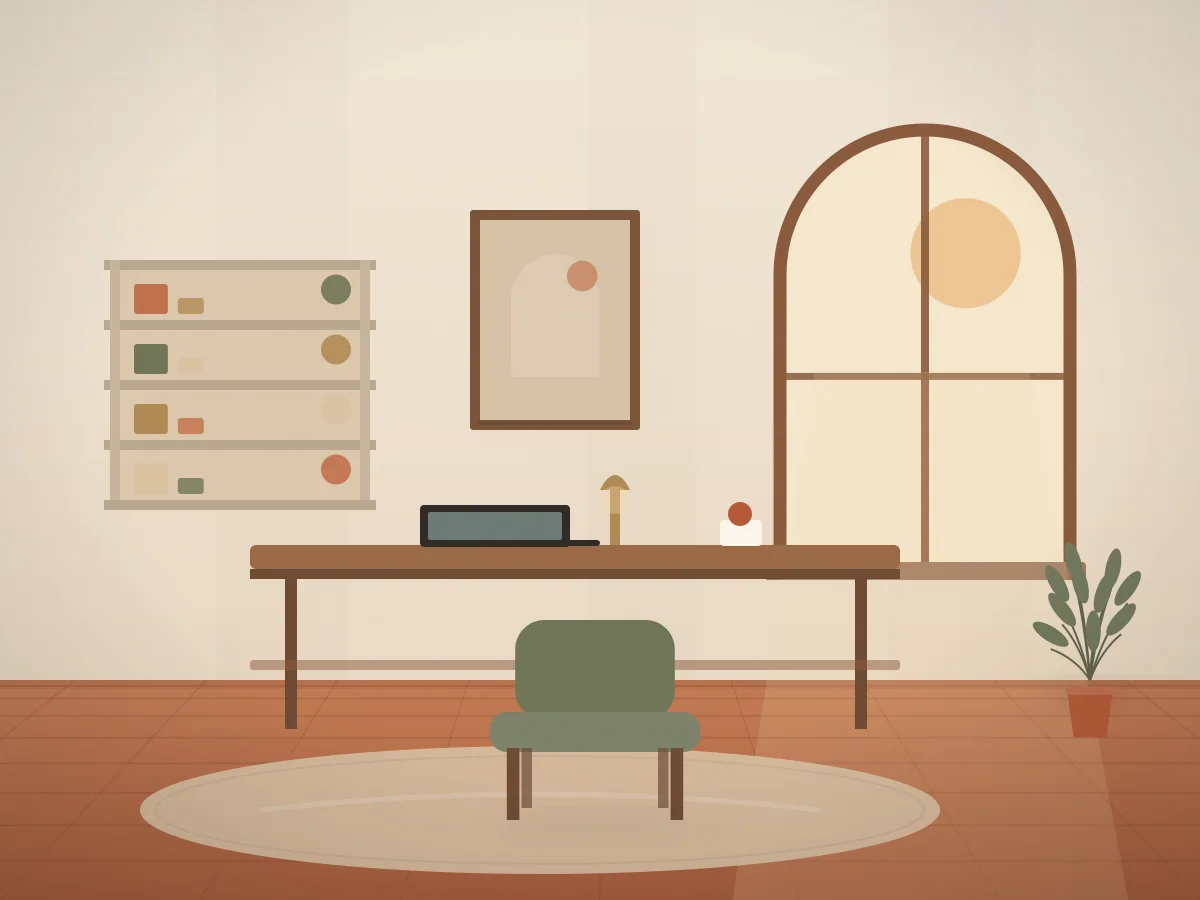
Most home offices fail in one of two ways: they are so minimal that they feel like a waiting room, or so full of equipment and paper that you avoid sitting down. Warm minimalism offers a third route. Borrow the calm of Spanish interiors — plaster, wood, natural light, a single beautiful object — and build a workspace that supports focus without feeling sterile.
Key takeaways
- Put the desk where the light is good and the background is calm, not simply against the emptiest wall.
- Choose a warm neutral palette and two or three natural materials.
- Hide the cables and the printer; display only what you genuinely enjoy.
- Invest in the chair and desk height before decorative accessories.
Define the work zone
Side light is best
If the office shares a room with the living area, give it a clear edge: a rug, a different wall colour, a shelving unit that turns the corner, or a desk positioned at right angles to the sofa. The boundary does not need to be a wall. It needs to tell your brain, gently, that this is where work happens.
Daylight is the first consideration. A desk perpendicular to a window gives you light from the side, which is better for screens than facing the window directly. If the only option is to face a wall, hang something at eye level that gives your gaze somewhere to rest — a print, a pinboard, a small shelf with two objects.
Choose warm, quiet materials
A warm minimalist palette usually combines an off-white or sand wall with oak, walnut or ash, plus one softer texture such as linen, wool or leather. Keep the desk surface as clear as possible; a wooden top with a subtle grain is more forgiving than glossy white. Matte finishes reduce glare and look better under warm light.
Add one material that changes with time: an aged brass lamp, a leather desk mat, a ceramic tray. These small surfaces make the room feel less like a corporate fit-out. Avoid filling the space with matching storage boxes; a single closed cabinet is usually better than a wall of identical files.
Get the ergonomics right
Desk, chair, screen
| Item | Target | Why it matters |
|---|---|---|
| Desk height | 720–750 mm | Keeps forearms level with the keyboard |
| Monitor top | At or just below eye level | Reduces neck strain |
| Screen distance | 50–70 cm | Comfortable focus without leaning |
| Chair seat height | Feet flat on the floor | Supports circulation and posture |
| Clear desk depth | At least 600 mm | Room for keyboard, notebook and hands |
If you are tall, a fixed-height desk may force you to raise your chair until your feet dangle. A footrest helps, but a height-adjustable desk is the better long-term investment. If you work on a laptop for hours, add a separate keyboard and raise the screen on a stand.
Light in three layers
Task, ambient, accent
Good task lighting is non-negotiable. A warm-white desk lamp with an adjustable arm, positioned to the side of your dominant hand, prevents shadows across the page. Add a softer ambient source behind the desk or in a corner so the contrast between screen and room is not too harsh. A small wall light or floor lamp is enough.
Keep bulbs around 2700–3000K for warmth, and avoid placing a lamp directly in your line of sight. If you take video calls, test the lighting from the camera’s position: a window in front of you is flattering, a window behind you turns you into a silhouette.
Conceal the machinery
The fastest way to make a home office feel calm is to hide cables, chargers and the printer. Mount a cable tray under the desk, use a single power strip with a switch, and route cables down one leg rather than across the floor. A lidded basket can hold the things you need but do not want to see.
For paper, use one vertical file instead of several stacks. Digitise what you can, but keep a slim folder for the documents you need to reach quickly. Open shelving should hold books and objects, not office supplies; use closed drawers for stationery and spare cables.
Add warmth without clutter
- A small olive tree or pothos in a terracotta pot.
- One framed print or photograph, hung at eye level from the desk.
- A ceramic dish for keys, glasses and a pen.
- A wool throw on the back of the chair for cool mornings.
- A candle or diffuser with a subtle cedar or fig scent.
The one-in, one-out rule
When a new object comes onto the desk, something else leaves it. This keeps the surface from becoming a slow-motion dumping ground and makes the room easier to reset at the end of the day.
Make it easy to close the door
A home office needs an end-of-day ritual. Clear the desk surface, put the laptop in a drawer or cover it with a cloth, and turn off the main light. If the office is in a living space, a folding screen or a curtain can hide the desk entirely. The goal is not to pretend work does not exist; it is to let the room change character when you stop.
For more inspiration, see how we use curved furniture and warm plaster in living spaces, and how small-space storage can keep a compact office organised. If you are choosing a desk to last, our solid wood furniture guide explains what to look for.